

Published by Niche Beverly | Luxury Outdoor Furniture Los Angeles
A Malibu beach house terrace is not just an outdoor space. It is the whole reason the house exists. You bought it or built it because of the view, the light, the particular quality of air that arrives from the Pacific on a late afternoon when the marine layer rolls back and the horizon turns the color of embers. Everything that happens on that terrace, from the first cup of coffee to the last glass of wine at midnight, is defined by what you put there.
Which is why getting the furniture wrong is so costly. Not just financially , though the cost of replacing outdoor furniture that has degraded after two seasons of Malibu’s real coastal climate is significant but experientially. The wrong sofa, the wrong material, the wrong configuration can make a spectacular space feel provisional. Like the furniture is a placeholder for something better that hasn’t arrived yet.
At Niche Beverly, we work with clients up and down the Malibu coast, from Point Dume to Carbon Beach, and the one thing every brief has in common is this: they want the terrace to feel as considered as the interior. Here is everything you need to know to get there.

Step One: Understand What Malibu Actually Does to Outdoor Furniture
Before you choose a single piece, you need to accept a fact that most furniture showrooms will not tell you directly: the Malibu coastal environment is genuinely harsh on materials that haven’t been engineered for it.
Salt air is the primary culprit. Within a mile of the Pacific — which covers almost all of Malibu proper — salt particles carried by the prevailing onshore winds settle on every exposed surface. On uncoated steel, the effect is measurable within months. Hinges seize. Frames spot-rust. Powder coats blister from the substrate outward. This is not a matter of negligence or bad luck; it is chemistry, and it happens to furniture that hasn’t been specified correctly regardless of how expensive it was.
UV exposure is the second force. Los Angeles averages 284 sunny days per year, and a west-facing Malibu beach house terrace with an ocean view receives direct sun from midday through sunset. UV radiation breaks down fabric dyes, softens powder coats, and degrades the resins in lesser synthetic weaves at a rate that interior furniture simply is not built to resist.
The third is the marine layer itself. Even on the sunniest days, Malibu’s coastal moisture — the morning mist that clings until ten, the evening dew — draws into cushion cores, into untreated wood grain, into synthetic weaves that weren’t designed for daily wetting and drying cycles. The difference between quick-dry foam and standard outdoor foam is the difference between cushions that feel fresh after a week of marine layer and cushions that develop a faintly damp, mildewed character by the end of summer.
None of this is a reason to compromise on design. It is a reason to choose the right materials from the start.
The Materials That Belong on a Malibu Terrace
Grade A, FSC-certified teak is the gold standard for coastal wood furniture. Its exceptional natural oil content makes it genuinely self-protecting against moisture and salt air — the same properties that have made it the material of choice for yacht decking and marine architecture for centuries. On a Malibu terrace, teak requires no heroics of maintenance: an annual clean and the occasional oiling if you want to preserve the warm honey tone, or simply leave it to silver gracefully into the driftwood-adjacent patina that many coastal homeowners actively prefer. The one non-negotiable: any teak furniture near the coast should use marine-grade stainless steel hardware — AISI 316 grade — at all joints, hinges, and fastenings. Standard steel fasteners will corrode even when the wood itself is performing perfectly.
Powder-coated aluminum with a marine-grade primer is the right answer for frames, bases, and structural elements. When done properly — multiple primer layers, electrostatically applied topcoat, no exposed raw metal at cut edges — powder-coated aluminum resists salt corrosion and UV degradation for decades without maintenance beyond an occasional wash. It is also lightweight enough that it won’t stress a cantilevered deck or cause issues with load calculations on elevated terraces, which is a real consideration for many Malibu cliff-side properties.
Solution-dyed acrylic fabrics are the correct choice for cushions in a coastal environment. The color in solution-dyed acrylic runs through the fiber itself rather than sitting on the surface, which means UV cannot bleach it from the outside in. Combined with quick-dry foam cores and removable, machine-washable covers, solution-dyed acrylic cushions hold their color and structural integrity across years of salt-air exposure and marine-layer moisture cycling. The European performance fabrics carried by our brands — proprietary to houses like Roda and Manutti — meet and often exceed these standards.
Marine-grade synthetic weaves — the technical rope and fiber materials used across collections from brands like Roda — are engineered with UV-stabilized polypropylene and polyester that resist fading, moisture absorption, and loss of tension over time. They bring a warmth and texture to outdoor seating that aluminum alone cannot achieve, and they perform at the coast without the maintenance demands of natural fiber alternatives.

How to Layer a Malibu Terrace: The Design Logic
The most considered Malibu terraces are composed in zones, not filled with furniture. The best starting point is a conversation with the space itself: where does the view land? Where does the afternoon sun fall? Where does the prevailing breeze come from, and where does it create a natural wind corridor? The answers to these questions dictate the layout before a single piece is chosen.
The lounge zone is typically the heart of the space — a deep modular sofa system oriented toward the view, with a low coffee table that doesn’t interrupt the sightline. For Malibu, we gravitate toward collections with genuinely deep seats (90cm or more) and low profiles that don’t compete visually with the horizon. Roda‘s Philia system, with its FSC-certified teak frame and hydro-draining cushions, is a collection designed with precisely this context in mind: the carabottino grating detail is quietly nautical, the proportions are calm, and the materials perform at the coast without asking much in return.
The dining zone, if the terrace is large enough to accommodate one, deserves the same material thoughtfulness as the lounge. A teak dining table with an aluminum or teak base, surrounded by chairs with outdoor-grade upholstered seats, creates a space that works for both the casual lunch and the formal dinner party without requiring a setup change. Ethimo‘s Bold dining table — available in rectangular and triangular formats — brings an architectural confidence to alfresco dining that suits the scale of a Malibu terrace particularly well.
The shade structure is where many Malibu terrace designs fall short. An unshaded ocean-facing terrace is genuinely unusable between noon and three on a summer afternoon, regardless of how beautiful the furniture is. The correct response is not a generic market umbrella — it is a shade solution engineered specifically for coastal exposure and wind loading. Tuuci, the marine-grade shade brand we carry at Niche Beverly, was born in the marine industry and engineers every component — from the anodized aluminum mast to the marine-grade fabric canopy — to perform in exactly this environment. Their parasols are anchored to resist the onshore winds that arrive in the late afternoon, and the modular components are individually serviceable, which means you are protecting a long-term investment rather than buying a consumable.
For terraces where a fixed structure makes more sense than a freestanding umbrella — particularly on properties with a covered outdoor area or an architectural overhang — Renson‘s louvered pergola systems offer motorized shade control that responds to both sun angle and wind, allowing the terrace to function comfortably across every hour of the day and every month of the year.
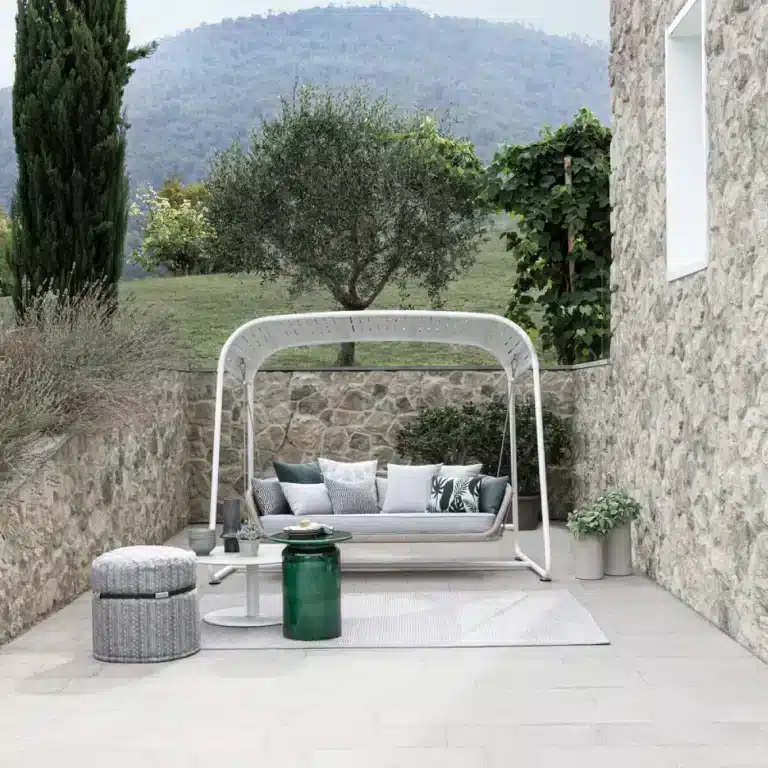
Accent pieces and finishing details are what separate a terrace that looks designed from one that looks furnished. A pair of Manutti lounge chairs positioned at a slight angle toward the view, distinct from the main sofa configuration, creates an intimate conversation spot that the main seating zone can’t replicate. An outdoor rug from Nanimarquina — woven in materials engineered for outdoor use — anchors the lounge zone and adds a layered warmth that bare hardwood or stone decking doesn’t provide. A side table at the right height, a low planter at the corner of the terrace, an outdoor lamp that extends the usable hours into the evening: these are the details that make the difference between a space you photograph and a space you live in.
A Note on Hardware and the Details Nobody Talks About
One of the least glamorous but most consequential decisions in a coastal furniture specification is the hardware. Every joint, hinge, and fastener on outdoor furniture near the Pacific should be AISI 316 marine-grade stainless steel. The difference between grade 304 and grade 316 stainless is a molybdenum additive that dramatically improves resistance to chloride corrosion — the specific chemical mechanism by which salt air destroys standard metal hardware. The premium-grade European brands we carry at Niche Beverly specify this as standard. It is not a detail they leave to chance.
Come to Niche Beverly
Our West Hollywood showroom at 8770 Beverly Blvd carries the collections best suited to Malibu’s coastal environment — from Roda and Ethimo for seating and dining, to Tuuci for shade, Renson for pergola structures, and Manutti for the accent pieces that give a terrace its finishing character. Our design team has worked on projects across the Malibu coast and understands the specific performance requirements and aesthetic language of this context better than most.
If you are designing a Malibu terrace from scratch or refreshing an existing one, we offer in-showroom consultations and on-site design visits. Trade pricing and contract volume are welcome. Reach us at info@nichebeverly.com or by phone at (310) 855-1755.
Niche Beverly | 8770 Beverly Blvd, West Hollywood, CA 90048 | (310) 855-1755 | info@nichebeverly.com Trade inquiries and contract projects welcome.
Explore More at Niche Beverly


