

There is something faintly defiant about a luxury daybed.
It refuses to commit. Not quite a sofa, not quite a bed, it exists in the margin between public and private life. In rooms obsessed with efficiency and singular purpose, the luxury daybed lingers in ambiguity. It invites pause rather than productivity. It suggests that a room can hold softness without apology.
The most compelling examples do not try to explain themselves.
A daybed occupies space horizontally, almost insistently. Unlike a traditional sofa that faces forward in polite alignment with a coffee table and screen, the daybed stretches. It extends along a wall or floats in a room like a low horizon line. Its presence disrupts the usual choreography. There is no obvious “best seat.” Instead, it proposes options: recline lengthwise, perch sideways, lean against a bolster, remove shoes and fold in.
Luxury, in this context, is not embellishment. It is permission.

Between Sofa and Bed
Historically, the daybed has wandered through interiors with quiet persistence. The Roman lectus served as a reclining platform for meals and conversation. Centuries later, interpretations emerged in neoclassical salons and modernist villas alike. In the twentieth century, the form reached a kind of distilled clarity in pieces like the Barcelona daybed by Ludwig Mies van der Rohe—a disciplined grid of leather and steel that felt as architectural as the buildings it inhabited.
That piece in particular did something radical: it stripped the daybed of overt ornament and elevated proportion to the role of ornament. The mattress became a plane. The legs, a statement of balance. No excess narrative. Just geometry and material in tension.
Contemporary luxury daybeds borrow from this lineage, whether they admit it or not. They rely on proportion first. A slight miscalculation in height, depth, or cushion density, and the piece becomes awkward—either too bed-like and inert, or too sofa-like and constrained. The luxury daybed exists in a narrow band of dimensional precision. It must support the body without dictating posture. It must allow repose without encouraging permanent residence.
The distinction sounds subtle. It is not.
The Discipline of Proportion
A well-designed daybed often sits lower than expected. That lowered stance changes everything. The room suddenly feels taller. Sightlines remain open. The body, when reclining, aligns closer to the floor, which creates an almost instinctive sense of grounding.
Yet if the platform dips too low, rising from it becomes inelegant. If it stands too tall, it loses its invitation to recline. The luxury daybed operates in millimeters.
Length matters even more. Too short, and the piece becomes decorative—an oversized bench masquerading as something more indulgent. Generous length, by contrast, signals confidence. It anticipates full extension of the body. It accommodates stillness. It acknowledges that comfort requires room.
Armrests, when present, complicate the equation. A single arm can anchor the form without boxing it in. Dual arms risk transforming it into a sofa by another name. Many of the most compelling examples avoid arms entirely, substituting bolsters or loose cushions that can migrate and adapt. Fixed architecture yields to flexible support.
Proportion is the language. Luxury is the fluency.
Material as Atmosphere
Material selection on a daybed is not merely tactile; it is atmospheric. Because the form is so exposed—often a simple platform and cushion—there is little to distract from surface.
Velvet absorbs light and deepens color, creating a sense of density and intimacy. Linen breathes and softens, catching daylight in a way that feels relaxed but deliberate. Leather introduces structure. It creases with use, documenting time in a way fabric cannot. Each material shifts the daybed’s identity.

Texture influences behavior. A slick leather surface encourages repositioning; the body slides and adjusts. A textured weave holds the body in place, creating a subtle friction that supports extended lounging. Cushion fill compounds the effect. Down-wrapped foam offers initial softness with underlying support. Solid foam reads firmer, more architectural. Too soft, and the daybed collapses into formlessness. Too firm, and it resists the very languor it promises.
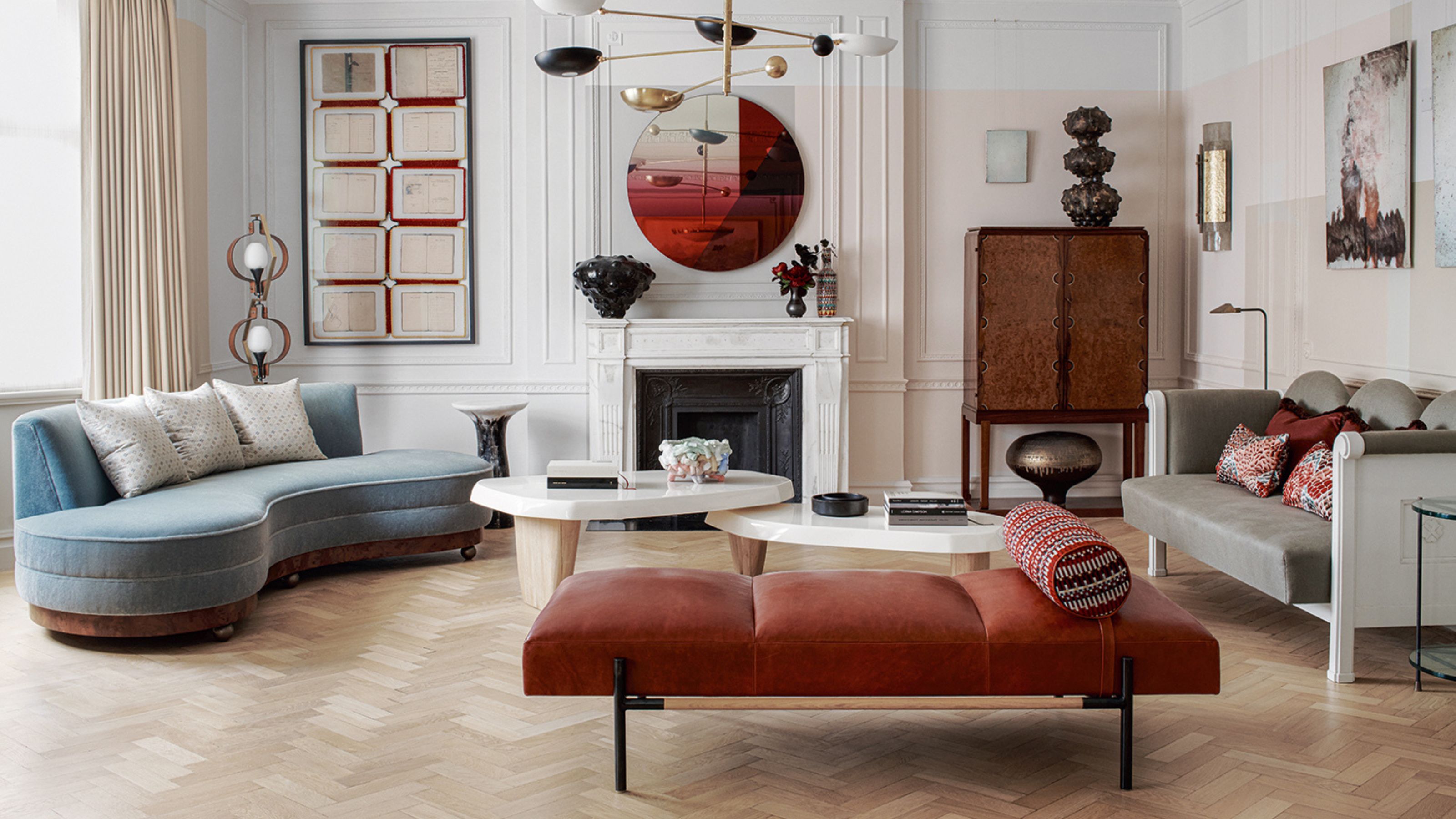
Color operates differently here than on a sofa. A daybed often reads as an object rather than part of a set. A saturated tone—deep olive, oxblood, midnight blue—can act as a visual anchor in a restrained room. Conversely, a pale neutral turns the piece into a canvas for light and shadow. The decision reverberates outward, influencing art selection, rug texture, even the perceived temperature of the space.
Material is not an afterthought. On a daybed, it is the thesis.
Placement as Intention
Where a daybed sits reveals how a room is meant to function.
Against a wall, it can operate as a generous alternative to a sofa, particularly in spaces that resist traditional seating arrangements. Under a window, it becomes a reading platform, a place suspended between interior and exterior. Floating in a room, it performs almost like a sculpture—approachable from multiple sides, shaping circulation without imposing rigid boundaries.
In open-plan interiors, the daybed can act as a soft divider. Unlike a full-height partition, it suggests separation without enforcing it. The backless form maintains visual continuity while providing psychological delineation. One zone transitions into another not with a wall, but with a shift in posture.
There is something quietly subversive about using a daybed in a primary living space. It signals that reclining is not reserved for bedrooms. It elevates rest to a visible, acceptable act. In homes increasingly shaped by productivity—home offices, screens, structured seating—the daybed reintroduces horizontal living.
It does not apologize for it.
Comfort Without Performance
Many pieces of furniture perform comfort theatrically. Oversized cushions, exaggerated depth, aggressive softness—these gestures broadcast relaxation. The luxury daybed tends to be more restrained. Its comfort is discovered rather than advertised.
Sit on it, and the initial impression may be composed, even tailored. Recline, and the intelligence of its construction becomes evident. Support appears where needed. Bolsters adjust. The surface yields slightly, then steadies. Good design reveals itself gradually.
There is also a social dimension. A daybed accommodates one body expansively, two bodies cautiously. It encourages diagonal occupation rather than strict adjacency. Conversation happens differently when participants are partially reclined. The hierarchy of upright seating dissolves. Interaction becomes less formal, less performative.
In this way, the daybed alters not only posture but atmosphere. It invites a slower tempo. It discourages rigid etiquette. It suggests that time can stretch.
The Detail in Restraint
Because the form is so elemental, detailing becomes critical. Seams must align. Tufting, if present, must justify itself structurally rather than decorate gratuitously. Legs—whether concealed plinths or slender metal supports—carry disproportionate visual weight. They determine whether the piece feels grounded or suspended.
A plinth base lends solidity, almost monolithic calm. Slim legs introduce lightness, shadow, a sense of lift. Neither is inherently superior, but each tells a different story about the room it inhabits.
Edges matter. A sharply defined cushion edge conveys discipline. A softly rounded edge softens the entire silhouette. These are small decisions with large consequences. On a daybed, there is nowhere to hide inconsistency.
The most successful examples exercise restraint. They resist excessive quilting, ornamental stitching, or conspicuous hardware. Luxury reveals itself in alignment, in density, in the quiet assurance that nothing extraneous has been added.
Living With It
Over time, a daybed develops a subtle biography. Fabric shifts slightly where bodies consistently recline. Cushions remember preferred angles. The surface may fade near a window, darken where touched frequently. These changes are not failures. They are evidence.
Unlike a bed, which is made and remade, the daybed often remains partially in use—an open book, a folded throw, a cushion nudged aside. It tolerates this informality better than most furniture. Its identity already exists between categories; it does not demand pristine presentation.
In smaller residences, a daybed can absorb multiple roles—guest accommodation, reading nook, afternoon retreat—without announcing the compromise. In larger homes, it can exist purely as indulgence, a dedicated platform for idleness. In either context, it resists redundancy. It earns its footprint.
Perhaps that is the quiet appeal. The luxury daybed does not chase attention. It does not rely on spectacle. It proposes an alternative to upright living, to the constant forward tilt of contemporary life.
It remains there, low and deliberate, offering a horizontal line in a vertical world.