

A console table is one of those pieces that quietly does a lot. It’s not the centerpieces of a room; it never tries to be but take it away and something feels missing. The entryway loses its landing spot. The hallway loses its only moment of personality. The sofa floats in the room with nothing anchoring it from behind.
The problem is that most people either buy one without thinking it through, or they style it once and never touch it again. This guide covers what a console table actually is, where it works, what to look for when buying one, and how to style it so it looks like it belongs rather than like it wandered in from another room.
Table of Contents
- What Is a Console Table?
- What Is a Console Table Used For?
- Styles to Consider
- Materials: What to Look For
- Standard Sizes & Dimensions
- Console Table vs. Sofa Table
- How to Style a Console Table
- Console Table Decor Ideas by Room
- Frequently Asked Questions
1. What Is a Console Table?
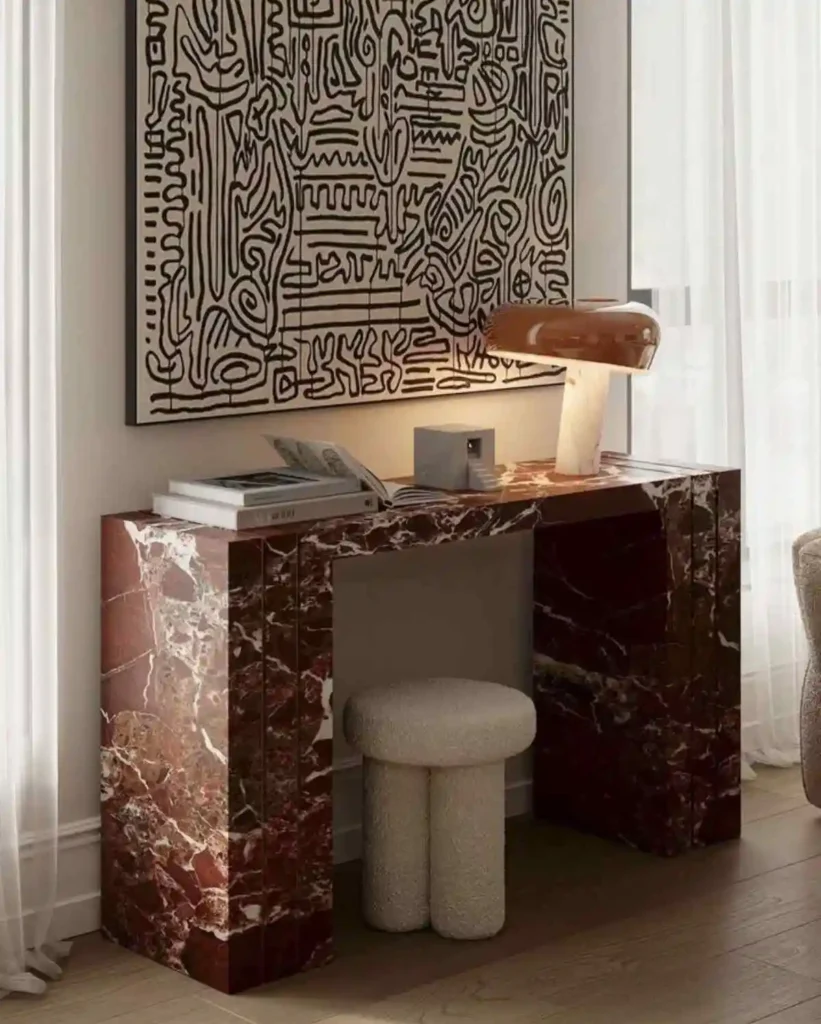
A console table is a narrow, typically rectangular table designed to sit against a wall rather than stand freely in the middle of a room. The name comes from the French architectural term for a bracket — early console tables were literally wall-mounted, with no back legs at all. Today the term covers a much broader range of pieces, but the defining character remains the same: shallow depth, moderate height, and a form that works along a wall rather than in open space.
It sits taller than a coffee table and narrower than a dining table. It doesn’t anchor a seating arrangement the way a sofa does, it exists at the edges of a room, doing quiet, consistent work. Some have drawers and shelves; others are nothing more than a top and four legs. The range in material runs from solid oak and marble to powder-coated metal and lacquered MDF. What ties them together is proportion and placement.
2. What Is a Console Table Used For?
More than most people realise, honestly.
Entryway. This is the most natural placement. A console table in a foyer gives you a surface for keys, mail, and the things that land when you walk through the door and it creates a first impression before a guest gets anywhere near the living room. A mirror above it, a lamp to one side, and the whole entrance feels thought about.
Behind a sofa. In open-plan spaces where a sofa floats in the middle of a room, the back of it can feel exposed and unresolved. A console table tucked directly behind solves this, it defines the seating area, creates a surface for lamps or objects, and makes the arrangement look intentional. This is one of the most underused placements in residential interiors.
Hallway. Long, narrow hallways are genuinely difficult to furnish. A slimline console, especially one with a shelf underneath, breaks up the length without blocking movement. Even a small one changes the character of a corridor that would otherwise just be a passage.
Home office. A console table with a lower shelf can work surprisingly well as a desk, particularly for a laptop setup. The shallow depth suits a wall placement, and it takes up far less visual weight than a dedicated desk.
Dining room. A console with storage can serve as a leaner alternative to a full sideboard, useful for overflow at dinner parties, wine, or table linens without the bulk.
3. Styles to Consider
The style of a console table should follow the room it’s going into, not the other way around. Buying something you like in isolation and then trying to make it work in a space that doesn’t support it is how you end up with a beautiful piece that never feels right.
Traditional. Solid wood, turned legs, carved details, decorative hardware. These work well in homes with period architecture or rooms that already lean warm and layered. They tend to be more formal, which is either a strength or a limitation depending on the context.
Rustic. Natural wood finishes, distressed details, visible grain and texture. Rustic console tables work best in spaces with an intentional informality, cabin-inspired rooms, farmhouse interiors, or anywhere that welcomes raw materials over polished ones.
Mid-century modern. Clean lines, tapered legs, walnut or teak finishes. This is probably the most versatile style right now because it plays well with both contemporary and more eclectic interiors without demanding too much from the room around it.
Industrial. Metal frames, raw or patinated finishes, sometimes paired with reclaimed wood tops. The Hardy Console at Niche Beverly is a strong example, a metal frame available in multiple finishes with top options ranging from stained oak veneer to marble, calacatta to marquinia. It works in loft-style spaces and anywhere with exposed materials or a harder-edged aesthetic.
Contemporary / minimalist. Almost no ornamentation, precise proportions, often in lacquer, glass, or polished metal. The Quincy Console by Meridiani sits in this territory, refined, high-quality finish, the kind of piece that integrates into a room rather than competing with it.
Console tables with storage. Worth treating as a category of its own. Drawers are ideal for entryways where you need to contain small items out of sight. Open shelves are better for display and easier to access quickly. If the table is going in a busy spot — a family hallway, an office — storage pays for itself fast.
4. Materials: What to Look For
Solid wood is the most forgiving over time. It takes wear, can be refinished, and tends to improve with age rather than deteriorate. Hardwoods — oak, walnut, teak — are the most durable. Watch out for MDF or particleboard frames sold simply as “wood.” They’re fine at lower price points but chip at edges and corners with regular use.
Metal frames (steel, iron, brass) age well and suit contemporary or industrial rooms. Brass and bronze finishes add warmth without bulk — particularly effective in entryways where you want presence without mass. Powder-coated steel is the practical choice for anything that might take a knock.
Glass tops make a small space feel less crowded and read as light and modern. The trade-off is maintenance — fingerprints and dust show up immediately on glass. If you go this route, tempered glass is non-negotiable, and nothing thinner than 6mm on a full-width top.
Marble tops are the premium option. Heavy, durable, unmistakably considered. The downside is that marble stains if unsealed and is cold in a way that can work against a warm room. Better for lower-traffic placements like behind a sofa than a hallway that takes daily use.
Lacquer finishes, matte or gloss, offer the widest colour range and photograph beautifully. The enemy is scratches — they show instantly on a lacquered surface and are difficult to repair invisibly. Keep lacquered pieces out of high-contact spots.

5. Standard Sizes & Dimensions
Console tables don’t follow a strict standard, but there are useful benchmarks that make the buying decision easier.
Height typically runs from 28 to 36 inches. Standard table height — around 29 to 30 inches — works in most contexts. If the table is going behind a sofa, try to match it roughly to the sofa’s back height, which is usually 30 to 33 inches. Too low and it disappears behind the sofa; too high and it looks like it’s climbing over it.
Depth is where most people underestimate. The typical range is 10 to 16 inches. Anything over 16 inches starts to feel like it’s encroaching on the room, especially in a hallway. For a tight corridor, 10 to 12 inches is more practical and usually sufficient. For a living room placement, you have more latitude.
Length ranges broadly from 40 to 72 inches. For an entryway, 40 to 48 inches works in most standard spaces. For behind a sofa, the most proportionate choice is something close to the sofa’s length — though intentionally shorter can also work if you want visual breathing room at the sides.
Always measure the wall before ordering. Include any outlets, switches, or architectural features that would limit placement — finding out after delivery is an expensive lesson.
6. Console Table vs. Sofa Table: What’s the Difference?
The terms are used interchangeably online, which causes genuine confusion when you’re trying to buy one. In practice, the distinction is mostly about placement intent.
A sofa table is designed specifically to go behind a sofa — it tends to mirror the sofa’s height and length more deliberately. A console table is the broader category; it can go anywhere against a wall and isn’t tied to a specific piece of furniture.
In most homes, the difference is academic. If a piece works in the space and does what you need it to do, the label doesn’t matter. Where it becomes relevant is dimensions — if you’re buying specifically for a behind-sofa placement, match the height to your sofa back and you’ll avoid the most common sizing mistake.
7. How to Style a Console Table
Styling a console table is really about building a small composition — a collection of objects that reads as considered rather than cluttered or sparse. A few principles that consistently work regardless of the room or the style of the table.
Work in odd numbers. Three objects almost always looks more natural than two or four. A lamp, a vase, and a small sculptural object. A plant, a stack of books, and a candle. The slight asymmetry makes an arrangement feel curated rather than symmetrically placed. Two objects tends to look like you ran out of ideas; four tends to look like a shelf at a shop.
Vary the heights. The most common mistake is placing everything at the same level. Bring in something tall — a lamp, a vase, a tall plant — something mid-height, and something low. It creates visual movement across the surface and gives the eye somewhere to travel.
Anchor the arrangement vertically. A mirror, a piece of art leaned against the wall, or a tall lamp above the table gives the composition somewhere to go above surface level. Without vertical anchoring, even a beautifully styled console table can feel flat and unresolved from across a room.
Leave breathing room. At least a third of the surface should be clear. If everything is filled, it reads as cluttered regardless of how individually nice each object is. Editing is the hardest part of styling, and it’s also the most important.
Add something living. A plant — even a small one — does something no decorative object can. It brings organic texture and a sense of life into what can otherwise be a very composed, static arrangement. A trailing plant on the lower shelf of a console is one of the most effortless styling moves you can make.
Some outdoor daybeds solve the side table problem in one piece — the Grand Belvedere has a built-in marble-topped side table as part of the frame. For indoor console styling, it’s more about the objects you bring to the table than the table itself.
8. Console Table Decor Ideas by Room
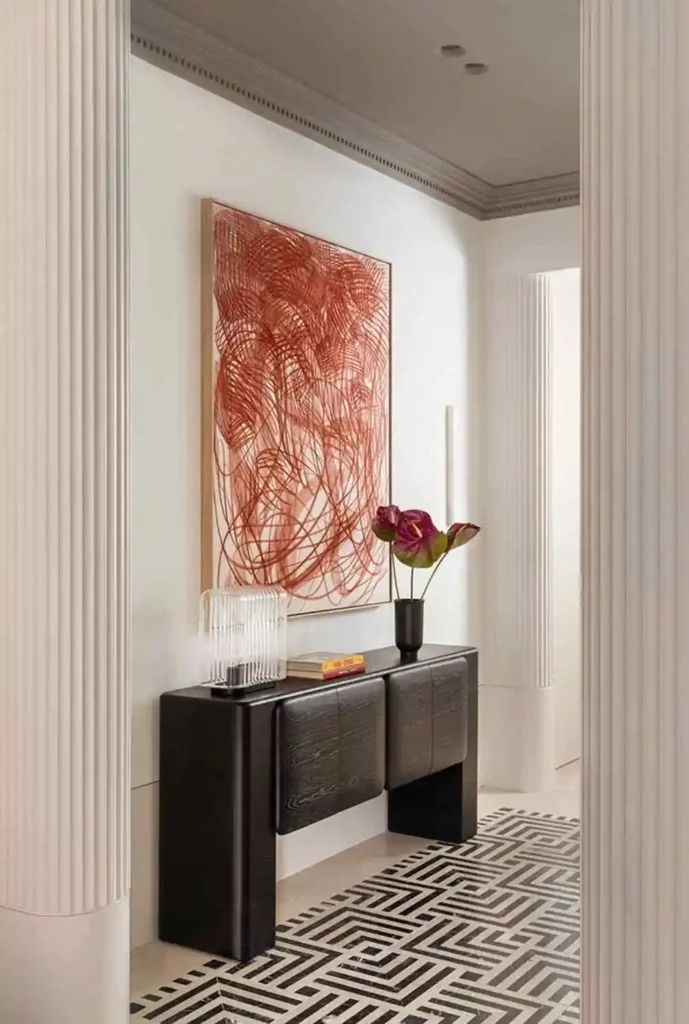
Entryway. This is the working console — it gets touched every day. Keep it functional first. A mirror above (full-length if the ceiling allows), a lamp to one side for warm light when you come home, a small tray or bowl for keys and coins, one plant. Don’t over-style it because it’ll get displaced the moment someone drops their bag. The table should do the visual heavy lifting; the surface should stay clear enough to use.
Behind a sofa. This is where you can be more expressive. Table lamps at each end — symmetry works well here, flanking lamps are the exception to the odd-numbers rule — with art or a large mirror on the wall between them. A low sculptural object or a trailing plant in the centre. This placement rewards confidence: a few strong objects look far better than many small ones.
Hallway. Keep it lean. One lamp, one object, done. A narrow hallway can’t absorb visual noise the way a living room can. Let the table itself do the work — a strong piece in a hallway doesn’t need much on top of it. If the hallway is long, consider two smaller consoles rather than one large one.
Living room wall. More latitude here. This is where a maximalist arrangement can work — layered objects at varying heights, mixed textures (ceramic, wood, metal, something woven), perhaps a gallery wall above rather than a single mirror. The key is a clear logic to the arrangement even if it’s busy.
Home office. Don’t try to decorate a working surface. One lamp, a small plant if there’s room, and whatever’s actually useful. A styled console in a home office just becomes an obstacle within a week.
If you’re furnishing a space in Los Angeles and want to see pieces in person, Niche Beverly’s indoor console and bookcase collection includes options from European designers across a range of materials and price points — worth seeing in context rather than just on a screen, particularly for anything in marble or lacquer where finish matters.
9. Frequently Asked Questions
What is a console table? A narrow, wall-placed table typically between 28 and 36 inches high and 10 to 16 inches deep. Originally a wall-mounted architectural feature, now a freestanding furniture category used primarily in entryways, hallways, and living spaces.
What is a console table used for? Most commonly as an entryway table or a surface behind a sofa, but also in hallways, as a slim desk alternative, or as a dining room sideboard substitute. The shallow depth makes it practical in spaces where a full-depth table wouldn’t fit.
How do you style a console table? Work in odd numbers, vary the heights of objects, anchor the arrangement vertically with a mirror or artwork, leave at least a third of the surface clear, and add one living element — a plant or flowers. The restraint is as important as the objects.
What size console table do I need? For an entryway, 40 to 48 inches long and 10 to 14 inches deep suits most spaces. For behind a sofa, aim for something close to the sofa’s length. Height should sit between 29 and 33 inches depending on context — taller for behind-sofa use, standard table height for entryways.
What’s the difference between a console table and a sofa table? A sofa table is designed specifically for behind-sofa placement and tends to mirror sofa proportions. Console table is the broader term. In practice the difference is minor — placement intent and dimensions are what actually matter.
Can a console table be used as a desk? Yes, particularly with a lower shelf for storage. The depth limits screen and keyboard real estate, but for a laptop setup against a wall it works well — and takes up significantly less visual weight than a dedicated desk.
What materials are best for a high-traffic entryway? Solid hardwood or metal frames hold up best. Avoid lacquer or glass tops in busy entryways — they show every mark. A honed stone or oiled wood top ages far more gracefully with daily contact.
What is console furniture? Console furniture is the broader category that includes console tables, console cabinets, and console units — essentially any narrow, wall-placed piece. Console tables are the most common type, but console cabinets with doors or full console units with integrated storage are also widely available.
Niche Beverly is a furniture store in Los Angeles carrying console tables and indoor furniture from European designers. Browse the full indoor collection or get in touch if you’d like a recommendation for your specific space.
Explore More at Niche Beverly


