
The round dining table is one of those pieces that seems obvious, almost invisible, until it isn’t. In a world full of rectangles and right angles, the circle quietly asserts itself. It resists hierarchy, corners, linearity. And yet it does more than just fill a room: it organizes it. It shifts how people sit, how they interact, even how a space feels. Place it in a suburban dining room, a loft with concrete floors, or a kitchen nook, and it transforms everything. People lean in differently. Conversations spread and fold differently. Bodies adjust. There’s a subtle choreography that emerges simply from the absence of corners.
The table’s presence isn’t just about shape. Proportion, material, and silhouette matter equally. Too small and it feels token-like; too big and it dominates the space in an awkward way. The diameter, height, edge, and support all communicate intention. The circle isn’t just geometry—it’s strategy. It’s a negotiation of intimacy, circulation, and scale that a rectangle rarely achieves without a lot of extra work.

Proportion and Presence
Proportion is the first thing you notice when approaching a round dining table. Unlike rectangles, which can stretch almost indefinitely, a circle dictates behavior. Everyone sits at an equal distance from the center, which is simple, elegant, democratic—but also limiting. Too small for the number of diners and it feels cramped, too large and the middle become a void, psychologically awkward. Height matters, too. Tables that sit a little too high or too low relative to chairs throw posture off and subtly ruin comfort. The ideal round dining table seems effortless, like it belongs. But achieving that balance is not effortless at all. It requires judgment, observation, a little intuition. Space and bodies have to negotiate with each other, and the table mediates the interaction.
Material and Texture
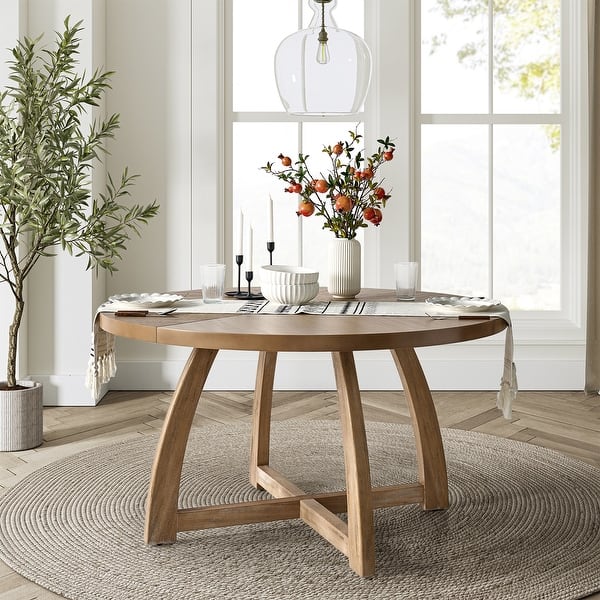
Material often defines a table more than its shape. A solid wood top communicates warmth, presence, permanence; its grain radiates naturally from the center, drawing attention inward. Glass makes the room feel open, but also unforgiving: fingerprints, smudges, and reflections demand attention. Marble and stone signal weight, authority, durability, but they can feel distant if not paired with softer elements. Metal—brass, steel, aluminum—reads modern, almost sculptural. Texture changes the perception entirely. Matte surfaces feel approachable, glossy ones commanding. The material is never neutral; it speaks as loudly as the shape itself. And when it’s paired with chairs, lighting, or rugs, it mediates the whole interior.
Pedestals, Legs, and Architecture
Support is more than functional. Pedestal bases free up legroom, which is one of the rare advantages of a circle. But pedestal design is subtle. Too thin, it feels fragile. Too thick, it looks heavy-handed. Multi-legged designs can introduce rhythm, but risk interrupting visual continuity. The base defines the table’s character. A carved wood pedestal feels traditional, ceremonial. Metal columns read contemporary, almost abstract. Every choice interacts with the circle above it, reinforcing—or undermining—the table’s presence.
Circles and Conversation
This is where the round dining table excels. It invites equality and intimacy, dissolving the head-of-the-table hierarchy. Everyone faces everyone else. Eye contact flows more naturally. Conversation becomes participatory rather than performative. In homes, it softens interaction, encourages attentiveness. In offices or collaborative spaces, it levels authority without needing protocol. Geometry shapes behavior. The circle nudges people toward inclusion. And it does it without any bells or whistles—just by being, by existing in the space with the right scale and proportion.
Scale and Placement
Scale is tied closely to placement. The table has to relate to walls, cabinetry, lighting, and walkways. A round table in a square room can soften corners, redirect movement, create rhythm. In irregular spaces, it echoes architectural forms, reinforcing harmony. Clearance matters. Chairs must pull out comfortably, paths must remain clear. Unlike linear tables, a circle has no “ends,” so every edge demands attention. Too close to a wall, and it feels trapped. Too far from the surrounding furniture, and it floats awkwardly. Its size and placement are inseparable from the room’s overall experience.
Lighting and Atmosphere
Lighting transforms how the table feels. A pendant centered above the table creates a halo, emphasizing symmetry. Shadows and daylight animate the surface differently than on rectangles. The table’s edge curves light in subtle ways, directing attention to the center, highlighting objects, and encouraging interaction. The circle has a radial focus. Everything points inward. Chairs, dishes, hands, gestures—they all orbit this center naturally. Light amplifies that choreography, sometimes in ways that aren’t even consciously noticed.
Objects, Ritual, and Surface
Objects behave differently on a round table. Centerpieces, bowls, trays—they all occupy radial space. A vase in the center anchors, but objects around it form a visual rhythm. Proximity matters. Everyone can reach items without stretching awkwardly. The circle encourages shared access. Placement feels intentional; clutter becomes more obvious. The table rewards thoughtfulness. It asks for composition without rigidity, participation without hierarchy.
Craft and Detail
Craftsmanship is critical. Curves expose imperfection. Grain, seams, veneers, joins—they all must align. A wobble or misalignment is immediately noticeable. The surface has to support not only dishes and hands, but interaction, weight, and repeated use. The pedestal must bear loads gracefully. Edges and finishes must feel complete. When done well, round dining table exudes quiet authority. It doesn’t need ornament. It signals permanence, care, and sophistication simply by being well-made.
Flexibility and Use
Round tables are surprisingly versatile. They adapt to kitchen nooks, formal dining rooms, lofts, or open-plan layouts. Six or eight diners? It works. Extra seating? Easy to integrate. Chairs rotate, benches curve, space absorbs movement. Unlike rectangles, the circle can flex without hierarchy or awkward angles. It lives with people rather than forcing them to live around it. And yet, it never feels generic. The circle’s strength is adaptability combined with presence.
Psychological and Social Impact
The table’s effect isn’t just physical; it’s psychological. It encourages equality, inclusion, intimacy. No one is at the “head.” Everyone is in sight of the center. In a family home, it changes the dynamic at dinner subtly: quieter voices, more balanced conversation, less posturing. In a collaborative space, it levels authority. Interaction is shaped by geometry as much as by design. A circle is more than form—it’s social engineering made beautiful.

A Statement of Geometry and Life
The round table is simple, but deceptively complex. Geometry, material, placement, and proportion all interact to create presence. In spaces dominated by rectangles, it softens corners and creates rhythm. It frames light, conversation, and objects. It doesn’t demand attention; it earns it quietly. A well-chosen round table feels alive. It invites participation, encourages connection, and reminds anyone in the room that design is never just about surfaces—it’s about how people move, talk, and live together around them. It’s a piece that quietly shapes life itself.