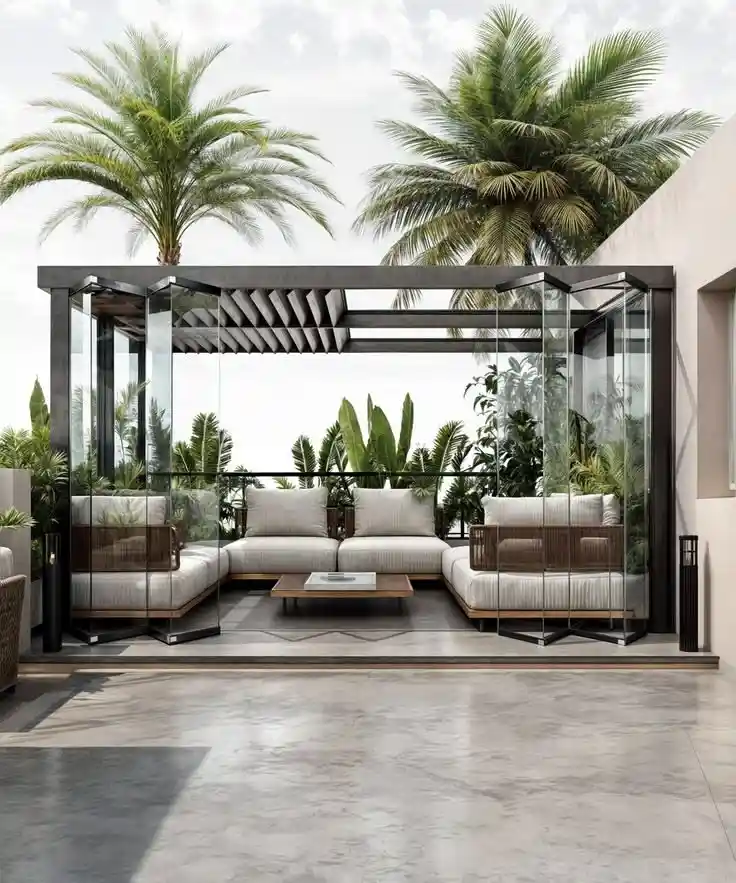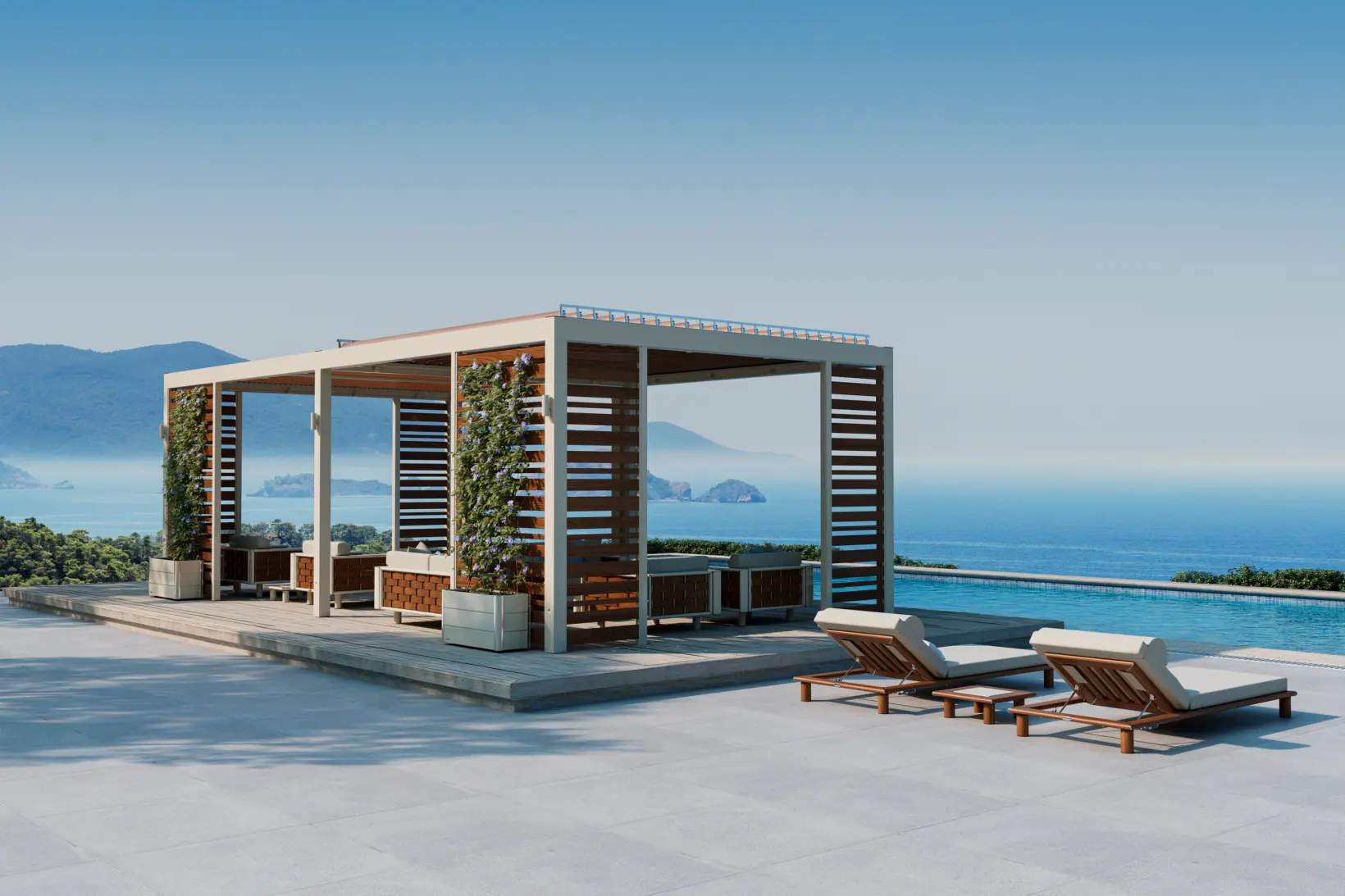

Rattan has always carried two personalities, the kind that exist somewhere between leisure and craft. Outdoors, it evokes sunlit verandas, colonial-era porches, or tropical escapes that feel easy and almost disposable. Indoors, though, it behaves differently. The current trend—landlocked rattan—pulls it from these expected settings and gives it weight and presence. It’s no longer something that drifts. A chair, a bench, or a console placed in a living room suddenly commands attention without shouting. It occupies space, defines lines, interacts with light and shadow, and subtly shifts how a room feels. There’s a kind of quiet insistence about it. Stripped of its airy, breezy context, rattan becomes punctuation, something that mediates between furniture, floors, and ceilings, while still carrying a sense of warmth.

Proportion and Scale
Proportion is tricky. Outdoor rattan is forgiving—rounded edges, flexible weave, light forms—but indoors, scale suddenly matters. A chair that looks delicate on a porch can feel lost or insubstantial in a vaulted living room. Designers are thickening lines, simplifying curves, reinforcing frames. The pieces need to anchor the space rather than float through it. Even small adjustments—an extra few centimeters in depth, a wider seat, stronger legs—change the impact completely. What was ephemeral becomes permanent. The furniture reads differently; it has to. The body notices the weight, the eye notices the lines. The room changes around it, quietly, almost without anyone realizing why.
Material Treatment and Color
Material matters even more indoors. Outdoor rattan is at the mercy of sunlight and humidity, but landlocked rattan is sealed, lacquered, treated to last under artificial lighting and regular use. The patina of age is no longer accidental; it is curated. Color has shifted too. Honey and tan are still common, but darker shades—smoked finishes, muted black, deep brown—anchor the pieces visually. Indoors, the material now has to coexist with wood, stone, and metal without looking like an afterthought. It reads as deliberate, intentional. It’s a subtle recalibration of perception: the material looks familiar but behaves differently.
Texture and Visual Rhythm
The texture of rattan indoors takes on a new role. It invites touch, but also commands the eye. Shadows fall differently under artificial light; daylight emphasizes subtle tonal shifts. A sofa with rattan sides, a chair with a woven back, a console with lattice panels—they all animate the room in ways smooth upholstery never can. The patterning is no longer decorative accident; it’s an active part of the composition. Touch and sight meet. You notice it when you sit down, when you reach for a cushion, even when you glance past it across the room. Texture is both material and mediator. It changes the way the space feels without saying a word.
Form Experimentation
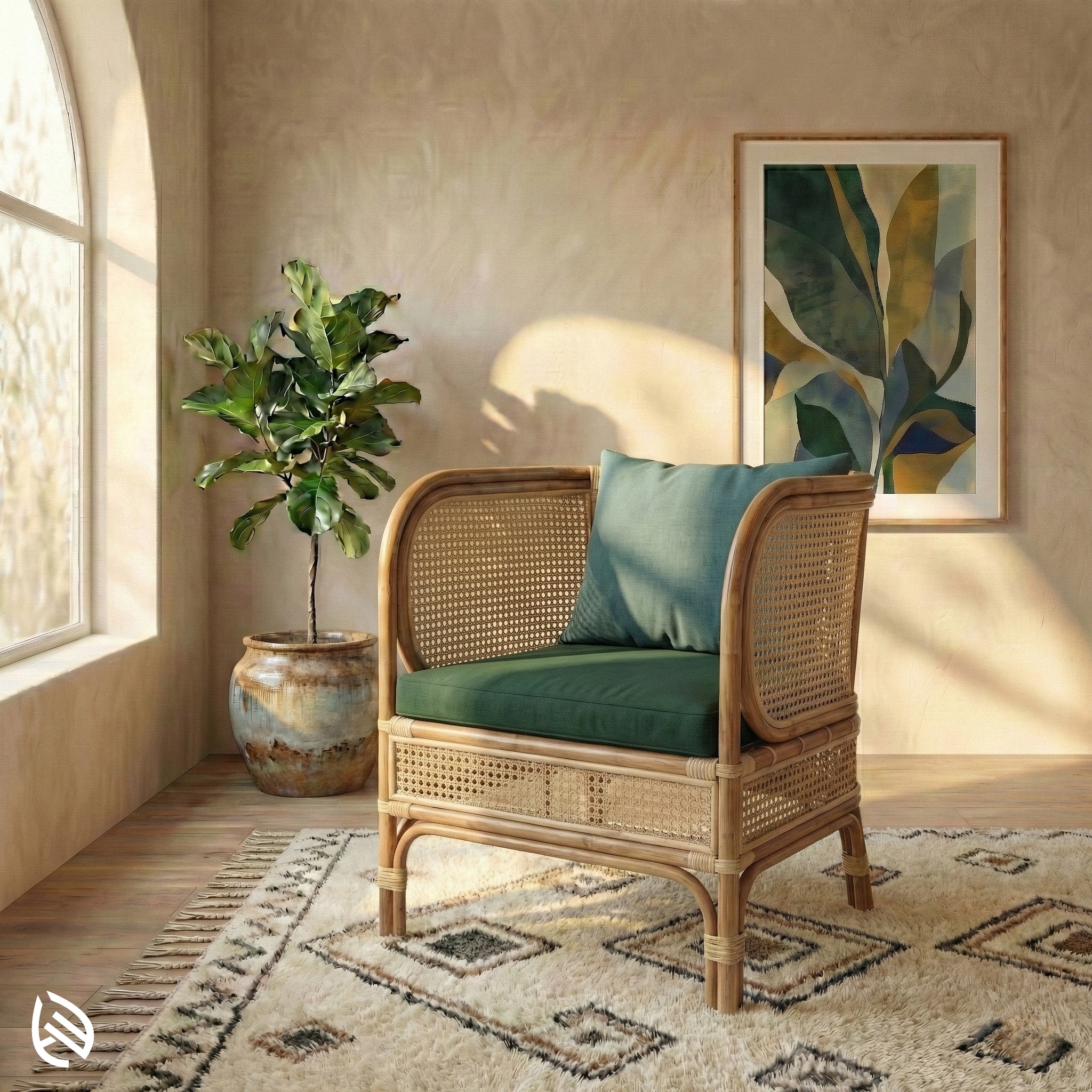
Forms are being pushed indoors too. While outdoor rattan favors curves and casual shapes, indoor pieces often explore rectilinear geometry, asymmetry, and hybrid constructions. Coffee tables combine rattan bases with stone tops, chairs mix woven panels into steel frames, and consoles float rattan drawers inside wood shells. The contrasts—rigid versus flexible, opaque versus open, warm versus cool—are deliberate. The pieces don’t just fill space; they define it. Rattan is structural now, part of the architecture rather than just a decorative element.
Placement and Spatial Influence
Where rattan sits indoors transforms its identity. A single armchair in a reading corner or a rattan daybed along a gallery wall can act as a visual anchor. Pairs of chairs can draw the eye, forming rhythm and shadows across the room. The gaps in the weave create intimacy without closing the space. In open layouts, landlocked rattan can subtly delineate zones without erecting walls. Circulation and social interaction are influenced by its placement. It occupies space in ways furniture usually doesn’t. It mediates how people move, where they gather, how they perceive proximity.
Cushions, Textiles, and Comfort
Textiles soften the material’s structure. Cushions, throws, and pillows are not merely for comfort; they modulate the perception of form. Deep, muted fabrics calm the rigidity of thickened weaves, while lighter textiles highlight the latticework. Placement is key: the right cushion can make a sharply angled armchair inviting, without undermining its architectural presence. The furniture becomes functional and approachable while retaining sophistication. The material demands thought in its use. It’s not casual anymore, but neither is it stiff.
Tables and Storage
Rattan tables and storage have evolved too. Outdoor coffee tables are too fragile indoors, so the trend favors thicker frameworks, solid tops, and sometimes glass overlays. The lattice remains visible but the pieces gain stability. They balance open and closed forms, lightness and visual weight. Nothing is accidental. A rattan console, coffee table, or side table now holds presence comparable to wood or metal pieces. They anchor rooms. They define circulation. They organize objects in a way that feels both natural and intentional.
Craftsmanship and Detail
Craft is essential. Indoors, sloppy weaving or uneven edges read as careless. Tight, even weaves, precise corners, clean transitions—all communicate thoughtfulness. Luxury comes through restraint, subtlety, and alignment. These are pieces that reward attention. Small details—how a leg joins a frame, how strands intersect—matter. They elevate a humble material to a component of serious interiors, one that can interact with light, shadow, and proportion in ways polished wood or metal alone can’t.
Material Dialogue and Context
Indoors, rattan speaks to other materials. Steel, glass, lacquer, and stone all create tension or complementarity. A rattan chair with steel legs, or a rattan console next to a marble floor, generates contrast—warm against cool, porous against reflective. These interactions are part of the sophistication. The material doesn’t shout. It doesn’t need to. It simply interacts, subtly shifting the tone of the room. Landlocked rattan becomes part of the conversation rather than an afterthought.
Behavior and Interaction
It also shapes behavior. A chair once casual becomes permanent. People sit differently, noticing the firmness of the weave, the way cushions settle, the slight give in the structure. Objects on rattan surfaces—books, trays, plants—require care. The furniture mediates the space, influencing circulation, interaction, and perception. Its presence is physical, visual, and psychological.

Lighting and Shadow
Light changes everything. Shadows cast through the weave accentuate texture and form. Accent lamps or directional lighting create patterns that animate surfaces. Daylight brings out subtle tonal shifts, revealing the depth of the weave. Landlocked rattan indoors rewards careful attention. What was casual and airy outside becomes dynamic and sculptural inside. Its lattice is not just decorative; it is an instrument of light, shadow, and rhythm.
A Statement of Sophistication
Ultimately, landlocked rattan makes a statement. It moves a casual outdoor material into a permanent, assertive indoor role. It’s judged not by nostalgia but by capability: proportion, texture, placement, and craft. Even simple pieces demand attention without shouting. They anchor, they define, they structure, they frame. Rooms with landlocked rattan feel grounded, textured, deliberate. Fibers once drifting in sunlit air now shape interiors. Even humble materials, thoughtfully applied, can carry authority and subtle sophistication in the right context.